

Imagine a landscape sweeping across northern Mesopotamia, six and a half thousand years ago. Small, circular houses made of packed clay rise from the earth, beehive-shaped domes clustered into early villages. Smoke from hearths drifts gently into a dry morning sky. This is the world of the Halaf Culture, a Neolithic civilisation that flourished between roughly 6000 and 5300 BCE. And from these quiet settlements came some of the most striking and technically remarkable pottery of the ancient world.
Today, we’ll explore how these early artisans shaped, decorated, and painted their ceramics—objects that still astonish archaeologists for their sophistication, precision, and beauty.
The Halaf culture is a prehistoric period of history which developed from the pottery neolithic era of the Natufians. There are three such cultures (Halaf, Samarra and Ubaid), with Halaf being the oldest.
Also, do check out my MEGA Mesopotamia Unit Study post to find out just where the Natufian people fit into the history of Mesopotamia. This huge post has lots of printable, videos, science experiments and, as always, stacks of suggestions for easy hands on activities you can do with your children! I am always adding new stuff to this post so do go and check it out.
Where Was the Halaf Culture?
The Halaf people existed between 6100 – 5100 BCE in the fertile valley of the Khabur River which flows through south-eastern Turkey, Syria and Northern Iraq. The archeologists named it after Tell Halaf in northeastern Syria where it was first discovered. We added some Halaf sites to our paper mache map:

There was enough rainfall here for them not to have to worry too much about droughts and irrigation. They lived in both circular (Tholoi) and rectangular houses made of clay bricks, straw and limestone boulders, in small villages.
The Halaf communities were largely agrarian—farmers, herders, and small-scale traders spread across parts of modern-day Syria, Iraq, and Turkey. Their villages were modest, but their craft traditions were anything but.
Refined Pottery
When archaeologists first uncovered Halaf pottery in the late 19th and early 20th centuries, the reaction was immediate: How could Neolithic villagers create something so refined?
Every pot, bowl, and jar is a testament to an unexpectedly advanced artistic culture.
Many pieces display paper-thin walls, almost symmetrical forms, and intricate geometric designs—all achieved without the aid of the potter’s wheel, which would not be used in this region until later periods.
The Halaf artisans relied entirely on hand-building and slow-turning techniques, yet their work rivals what many cultures would produce thousands of years later.
I have made some notepages to go along with this lesson which you can download and print, should you wish:
Halaf Culture Pottery
Clay, Forming, and the Pottery Process
Creating Halaf pottery began with selecting the right clay.
Halaf potters were deliberate: they used fine-grained clays, often cleaned and filtered to remove impurities. The clay body was then mixed with temper—materials such as fine sand or crushed pottery—to make it more durable and easier to shape.
Because true rotating wheels had not yet been invented here, these artisans used what archaeologists call a slow wheel, sometimes referred to as a tournettes or hand-turned platform. It wasn’t spun mechanically. Instead, it rotated manually, allowing the potter to shape the vessel slowly and carefully.
Halaf Techniques
Some pieces, however, were made entirely by hand, using techniques like:
- Coiling – building up layers of clay snakes (see video below)
- Paddle and anvil – thinning and smoothing walls with rhythmic tapping
- Pinching and pressing for smaller bowls
Once formed, the pot’s surface was meticulously smoothed. Many Halaf vessels are so uniform that it’s easy to forget they were made without machines. The artisans often applied a thin slip, a watered-down clay mixture that created a smooth, light-colored surface—the perfect canvas for painting.
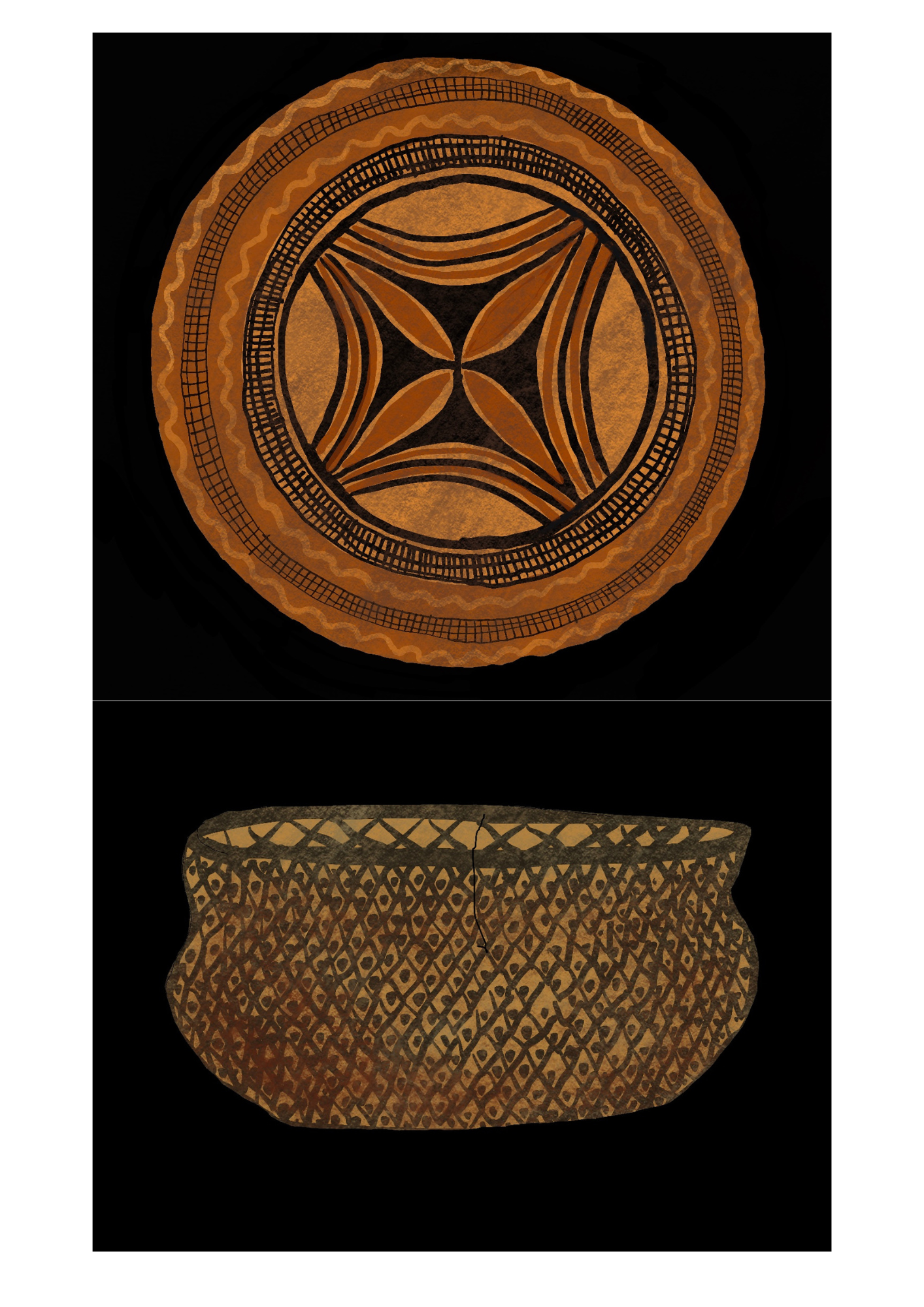
The Halaf culture were known for their fine ceramics, which showed a high level of craftsmanship. Here you can see a plate and a bowl, which, when compared to the Natufian plaster bowls we made, you can see were finer and more beautiful, decorated with painted geometric patterns.
Pin this post to bookmark it for later!

The Halaf people made their ceramics from hand coiled pots. Coiling pots is the oldest ceramic technique and has been carried out across most continents at some time in their history. These coiled pots are used for storing or cooking food, for ceremonial purposes and are often decorated.
I have done a quick video showing you how to create these types of pots:
Coiling pots means taking long strands (or coils) of clay and coiling the ropes into the pot shape desired. The craftsmen would then pinch together the strands and smooth them out until the pot is formed. The potters left their creations to dry, before painting them with predominantly geometric patterns. I have created some printable pictures of the two pots I attempt to recreate in the video below, so do feel free to download and print out:
A Revolution in Painted Decoration
What sets Halaf pottery apart is not just the form but the decoration. These vessels represent some of the earliest fine painted ceramics in the ancient Near East.
The Color Palette
Halaf pottery is primarily painted in:
- Deep reds
- Warm browns
- Black lines and accents
- Occasionally, white highlights
These pigments came from minerals available in the environment. Iron oxides produced the reds and browns. Manganese or carbon produced black. White likely came from calcite or kaolin-rich clays.
The Signature Style
Halaf pottery is instantly recognizable because of its striking geometric motifs. Common patterns include:
- Interlocking triangles
- Checkerboards
- Cross-hatching
- Dot-filled shapes
- Starburst and rosette patterns
- Concentric circles and spirals
These designs were often arranged symmetrically, wrapping perfectly around the curvature of bowls and jars. The lines are incredibly fine—some no thicker than a hair. This precision suggests the use of brushes made from animal hair or fine plant fibers.
Symbolic Imagery
In addition to geometric motifs, some Halaf pottery features stylized animals:
- Birds
- Goats
- Gazelles
- Snakes
These weren’t realistic portrayals, but symbolic ones—simplified outlines or repeated patterned forms, suggesting meaning or cultural significance. Some scholars believe these motifs hint at early spiritual or ritual ideas, possibly connected to fertility or protection. But because the Halaf left no written record, the true meanings remain partly mysterious.
How They Painted It — Techniques and Tools
Now let’s look more closely at the painting process itself.
Step 1: Preparing the Surface
Once the vessel was leather-hard—not too wet, not too dry—the potter smoothed the surface. Many pieces feel almost polished. This smoothing ensured that paint adhered evenly and that the final designs would look crisp.
Step 2: Applying the Slip
Most Halaf pottery has a slip coating in shades of cream, buff, or reddish tones. This slip created a uniform background color and helped the paint sit sharply on the surface.
Step 3: Painting the Designs
The paint, made from mineral pigments mixed with water or a thin clay base, was applied with small brushes. These brushes might have been:
- Animal-hair tips bound to sticks
- Bundles of fine plant fibers
- Reed or bone styluses for very fine lines
The decorative process required extraordinary control.
Imagine painting a perfect spiral on a curved surface that’s slightly damp, with a handmade brush and no mechanical rotation. Yet Halaf artisans painted not only spirals but also grids, crosshatches, and repeated geometric symbols—almost flawlessly.
Step 4: Layering and Detailing
Some Halaf vessels exhibit multi-layered patterns: a base color applied first, then a second pigment on top. The interplay of dark and light colors created contrast and visual rhythm.
Step 5: The Firing
The firing process locked the decoration into the clay.
Halaf potters used open fires or simple updraft kilns, where temperature control was limited. Yet remarkably, they consistently achieved stable colors and well-fired surfaces. This suggests a deep empirical knowledge of firing techniques—knowing how long to fire, when to add fuel, how to manage air flow.
Firing also transformed the pigments, deepening the reds and blacks and giving Halaf pottery its characteristic earthy brilliance.
Why Halaf Pottery Is So Important
Halaf pottery matters for several reasons.
1. Technological Sophistication
It represents an early high point in ceramic technology.
The thin walls, refined clays, and controlled firing show a level of skill that is surprising for the time period.
2. Shared Artistic Identity
Because Halaf pottery is found across a wide geographic range, its distinctive style suggests strong cultural connections between distant communities. Pottery may have been traded, gifted, or made by wandering artisans.
3. Precursor to Later Traditions
Halaf painting influenced later ceramic cultures in northern Mesopotamia. The emphasis on symmetry, geometric motifs, and controlled linework became hallmarks of later prehistoric pottery traditions.
4. A Glimpse of Belief and Symbolism
The imagery gives us rare hints about Neolithic worldviews—ritual, nature, and perhaps early symbolic language expressed through repeating motifs.
5. Aesthetic Achievement
Even today, the pottery stands out for being simply… beautiful.
Its designs feel modern: bold contrasts, repeating geometric patterns, clean lines. Designers, artists, and ceramicists continue to study Halaf work because its elegance transcends time.
Pin this post to bookmark it for later!

Daily Life vs. Ritual Use
Not every Halaf pot was a masterpiece.
Archaeologists find two broad categories:
Everyday Ware
These vessels are plain, undecorated, and thicker. They were used for:
- Cooking
- Storage
- Transporting grains, seeds, and liquids
Fine Painted Ware
The highly decorated pieces—the ones archaeologists admire most—were likely reserved for:
- Rituals
- Feasting
- Social ceremonies
- Burial offerings
- Elite households
Some painted vessels are so delicate that they were almost certainly not used every day. Their quality suggests a social function: perhaps gifts, status symbols, or items connected to communal identity.
The Legacy of Halaf Pottery
In the end, the story of Halaf pottery is the story of innovation—humans pushing the boundaries of what’s possible with earth, fire, and imagination.
This pottery traveled far. Halaf ceramics appear in sites hundreds of kilometers apart, suggesting long-distance exchange networks. As the Halaf culture eventually transitioned into the later Ubaid culture, some pottery traditions blended into new styles. But the legacy of Halaf craftsmanship endured.
Today, museums across the world preserve these vessels: small bowls painted with perfect spirals, jars with delicate cross-hatching, plates covered with geometric stars. Six thousand years old, but still crisp, still expressive, still engaging the eye.
They remind us that long before writing, long before cities, creativity was flourishing.
People expressed identity, belief, and beauty using the materials around them—earth shaped by hand, decorated with pigments, fired with care.
Halaf pottery is not just an artifact of the past.
It is evidence of humanity’s enduring desire to create meaning and beauty… even in the simplest of objects.
As we reflect on the Halaf culture, its pottery tells us more than any surviving structure or tool. It speaks of skill, symbolism, community, and artistic vision. It connects us to craftspeople who, thousands of years ago, dipped brushes into mineral pigments and painted the first great ceramic masterpieces of the ancient Near East.
And through their work, the Halaf still speak to us today.
The First Ever Stamp Seals
The Halaf Culture was not just known for its exquisite pottery, or its its early architecture… they are also credited with inventing something even more mysterious: stamp seals.
Small enough to fit in the palm of a hand, yet rich with meaning, these carved objects open a window into the social, economic, and symbolic world of the Halaf people. Today, we explore what they were, how they were made, what they may have meant, and why they remain such intriguing artifacts of early human organization.
What Are Halaf Stamp Seals?
Stamp seals are small, carved objects—usually stone—engraved with patterns or symbols. When pressed into soft clay, they leave an impression: a repeated mark unique to the stamp and, presumably, to the person who owned it.
In the Halaf world, these seals appear as early as the 6th millennium BCE. They are among the earliest personal or administrative identifiers anywhere in Mesopotamia.
Each seal is distinctive:
- Some are geometric, featuring spirals, grids, and cross-hatched designs.
- Others show stylized animals—gazelles, snakes, birds, or abstracted creatures.
- A few display patterns so complex they resemble miniature works of art.
These seals were never large. Most were between 2 and 4 centimeters across. But despite their size, they carry big implications for how the Halaf world functioned.
Materials and Craftsmanship
To create a stamp seal, the artisan began by selecting durable, workable stone. Materials included:
- Steatite (soapstone), soft and easy to carve
- Chlorite and calcite
- Occasionally, hard stones like obsidian or basalt
The stone was shaped into different forms: round, rectangular, lenticular, button-shaped, or even zoomorphic. Many have a perforated hole, suggesting they were worn on a cord around the neck or wrist.
Carving the Design
The artisans used simple tools—flint blades, bone points, and abrasive sands—to incise the patterns. Yet the precision they achieved is remarkable. Lines are evenly spaced, curves perfectly balanced, and repeating motifs expertly arranged.
Unlike later Mesopotamian cylinder seals, which roll to create long images, Halaf seals were stamps—pressed once to create a single impression. But Halaf designs often show an early interest in repetition, symmetry, and patterned order. They hint at a developing symbolic system, one that may have influenced later administrative practices.
The Function — What Were They For?
This is perhaps the most fascinating question. What did the Halaf people use these seals for?
Archaeologists have proposed several possibilities. None exclude the others; in fact, all may have been true at different times or places.
1. Marking Ownership
One of the most widely accepted functions is marking ownership.
If a pot of grain, a bundle of textiles, or a clay storage bin belonged to someone, the owner might press their seal into a lump of clay attached to the item.
Just like a signature, the seal impression would identify the owner.
2. Securing Storage and Containers
Seals could serve a security purpose.
A clay stopper on a jar or storeroom door might be stamped to show it hadn’t been opened. If the seal was broken, it meant the container had been tampered with.
This marks one of the earliest steps toward administrative control, a system that would later grow into the complex bureaucracy of ancient cities.
3. Social Identity or Status Markers
Some seals were too elaborate—and too personal—to be only practical tools. They may have held symbolic or social significance:
- Badges of identity
- Tokens of status
- Amulets with protective symbolism
- Or signs of membership in particular families or groups
Worn on necklaces or belts, a seal could display the owner’s place within the community.
4. Ritual or Ceremonial Uses
Intricate designs involving animals, symmetrical patterns, or possible religious symbols hint at ritual meanings. Some seals were found in burials, suggesting they were special objects, perhaps imbued with spiritual value or used during ceremonial activities.
5. Early Communication
Although not writing, seal motifs may represent an early form of symbolic communication—recognizable patterns that conveyed meaning within the community.
Whatever their purpose, Halaf stamp seals are among the earliest artifacts showing humans using symbols to organize society.
Types of Designs and Their Meanings
The range of Halaf designs is astonishing, especially given their age.
Geometric Patterns
These are the most common, including:
- Parallel lines
- Cross-hatching
- Chevron and zigzag motifs
- Rosettes or star shapes
- Dotted fields
Such patterns might reflect early counting systems, clan identities, or simply aesthetic preferences. But the precision suggests intention, not randomness.
Animal Motifs
Animal imagery appears on a significant number of seals:
- Birds, possibly symbolizing the spiritual world
- Goats or gazelles, tied to hunting or pastoral life
- Snakes, associated in many cultures with protection or renewal
- Felines or abstract creatures, perhaps mythic
While their meanings remain uncertain, they certainly held symbolic weight.
Anthropomorphic Designs
Very rare, but some seals hint at human figures or stylized bodies, possibly representing deities, ancestors, or community leaders.
Abstract Forms
Some designs defy classification—spirals, wave patterns, and repeated curves that seem almost hypnotic. These might represent natural forces, water, celestial bodies, or purely symbolic concepts.
How Stamp Seals Were Used in Daily Life
Imagine a Halaf village.
Clay is everywhere—used to build homes, storage bins, ovens, and tools. Within this clay-rich environment, stamp seals make perfect sense.
A woman storing barley in a jar might plug the top with clay and press her seal into it.
A trader preparing goods for exchange might mark each item with his distinctive emblem.
A community leader might use a seal to legitimize a ritual or record a communal agreement.
The seals are small, portable, and personal. They were likely carried every day, tied to garments, hanging on necklaces, or stored in baskets with other valuables.
Seals as Social Anchors
Beyond their practical uses, stamp seals give us insight into Halaf social structure.
Indications of Identity
In a world without writing, a seal was a clear indicator of “who you were.” Every seal is different; none are mass-produced. This suggests a society where individual identity mattered—where marking one’s belongings or role was an important social act.
Evidence of Emerging Hierarchy
Some seals are far more skillfully made than others.
While many are simple, others display intricate artwork and high-quality stone. This variation may hint at differing levels of wealth, status, or access to specialized artisans.
Networks of Exchange
Seals found far from their presumed origin sites indicate trade and mobility. A seal impression on storage clay could travel with goods, marking ownership across distances.
Community Regulation
The presence of sealed containers suggests rules: agreements, protection of resources, or accountability within the community. In a small-scale society, seals may have helped maintain trust and fairness.
Making a Seal Impression — A Step-by-Step Reconstruction
Let’s imagine the process.
1. Preparing the Seal
A person chooses their seal—perhaps inherited from a parent, or carved by a local artisan.
2. Preparing the Clay
Soft clay is shaped into a small disk or pressed onto the stopper of a jar. It must be moist but firm enough to hold detail.
3. Pressing the Seal
The stamp is pressed gently but firmly into the clay.
The impression appears instantly—crisp patterns capturing every carved line.
4. Drying and Hardening
The clay dries in place, or is sun-baked for durability. As long as the seal mark remains whole, the container is considered closed and secure.
A broken seal is a broken promise—and a sign something has been disturbed.
The Mystery of Abandoned Seals
Many Halaf seals were found discarded: lying in abandoned houses, buried in refuse pits, or placed intentionally in graves. Why would someone leave behind such a personal object?
There are several theories:
- Loss of social identity: A seal might be abandoned when its owner died.
- Ritual deposition: Seals may have been considered spiritually charged.
- Change in settlement patterns: Halaf people frequently moved. Some objects were left behind.
- Replacement: New seals may have replaced old ones, just like signatures evolve.
These abandoned seals provide priceless clues—but they also remind us how much we still don’t know.
Legacy and Influence
Though small, Halaf stamp seals had a lasting impact.
1. Predecessors of Administration
They represent an early step toward the complex accounting systems seen later in Mesopotamia—bullae, clay tokens, and eventually, writing.
2. Early Personal Signatures
Each seal is unique, foreshadowing the idea of personal identity and authority.
3. Artistic Influence
The patterns found on Halaf seals—spirals, grids, rosettes—echo in later pottery and decorative traditions.
4. Cultural Continuity
As the Halaf culture transitioned into the Ubaid period, seals continued to evolve, becoming more standardized and more closely tied to administration.
In the quiet villages of the Halaf world, long before cities rose or writing began, people carved tiny symbols into stone—symbols of identity, of property, of belief.
These stamp seals were more than practical tools. They were also:
- expressions of artistry and social order.
- personal markers in a growing network of exchange and cooperation.
- humanity taking its first steps toward organized communal life.
Each seal impression is a signature pressed in clay across 6,000 years of history.
And even today, when we look at them—those spirals, those animals, those carefully carved patterns—we hear echoes of the people who made them, who carried them, who stamped their lives into the fabric of the ancient world.
Through their seals, the Halaf still speak. All we have to do is listen.
I have also created some printable pictures of the Halaf Culture Stamp Seals for you to use whilst you carve your own. These can be downloaded below (This also includes a museum label to use in your end of unit presentation):
Pin this post to bookmark it for later!

The Halaf people seemed to die out around 5000BC. It seems most likely that they were simply absorbed into the up and coming Ubaid culture, rather than there being any major catastrophe causing their demise.
We will be covering the Ubaid culture in another post.
Discover more from ANGELICSCALLIWAGS
Subscribe to get the latest posts sent to your email.