

This post, about Jane Austen’s Sense and Sensibility, contains a printable summary of Sense and Sensibility with some discussion questions, in addition with an infographic on Jane Austin. At the end of the post, there are fifteen hands-on activities to choose from to truly bring your study alive.
Jane Austen’s Sense and Sensibility
On 30 October 1811, a new novel appeared in London.
Its title was Sense and Sensibility.
The author wasn’t named.
Instead, the title page described the book as being written: ‘By a Lady.’

Today, we know that the mysterious author was Jane Austen, one of Britain’s most famous novelists. But in 1811, most people buying the three-volume novel would not have seen her name anywhere on it.
That makes the publication of Sense and Sensibility much more than a literary event. It gives us a fascinating opportunity to explore what it meant to be a woman, a writer and an aspiring author in Britain during the Regency period.
For a homeschool history study, Jane Austen’s first published novel can be a doorway into the world she lived in: country houses and crowded cities, balls and servants, handwritten letters and expensive books, strict social expectations, and rapidly changing technology.
And, perhaps most importantly, it allows us to ask a fascinating question:
Why was a woman who wrote one of the most successful novels of her day not allowed to put her own name on the book?
Jane Austen’s First Published Novel: Sense and Sensibility
Thomas Egerton of Whitehall published Jane Austen’s Sense and Sensibility in London on 30 October 1811.
It was published in three volumes, as was common for fashionable novels of the period, and the title page identified the author only as ‘A Lady.’
The novel tells the story of the Dashwood family, particularly sisters Elinor and Marianne Dashwood.
Elinor is generally associated with sense: she is thoughtful, practical and careful about controlling her emotions.
Marianne, in contrast, represents sensibility: she is passionate, romantic and much more willing to express what she feels.
But Austen’s novel is much more complicated than simply asking whether it is better to be sensible or emotional.
It explores relationships, money, inheritance, reputation, social expectations, family responsibilities and the choices available to women.
These subjects were not abstract questions for Austen’s readers.
They were part of everyday life.
A Novel That Took Years to Write
One of the most interesting things to discover about Jane Austen’s Sense and Sensibility is that Austen didn’t suddenly sit down in 1810 and write a novel because she wanted to become a published author.
The story had a much longer history.
The earliest version was written around 1795, when Austen was about nineteen. It was known as Elinor and Marianne and was probably written as a series of letters. Austen later transformed it into a prose narrative and revised it again many years later.
Austen substantially revised the manuscript around 1809–1810, after she, her mother, and her sister moved to Chawton in Hampshire.
This means the novel that finally appeared in 1811 developed over about fifteen years.
Imagine writing a story as a teenager and then continuing to rethink, rewrite and improve it into adulthood.
For children, this is a wonderful reminder that writing doesn’t have to happen all at once.
A story can grow with its author.

What Was Happening in Britain in 1811?
To understand Austen’s world, it helps to step outside the novel’s pages.
Britain in 1811 was undergoing enormous changes.
This was the beginning of the Regency period in the usual historical sense. In February 1811, George, Prince of Wales, became Prince Regent because his father, George III, was considered incapable of ruling due to illness.
The Prince Regent would later become George IV.
The Regency is often imagined as a glamorous world of elegant dresses, country houses, dances and grand parties.
There certainly was plenty of that.
But there was another side.
Britain was also at war with Napoleonic France.
The Napoleonic Wars affected families throughout Britain. Men served in the army and navy, trade was disrupted, prices were affected, and the country spent enormous amounts of money on war.
At the same time, Britain was experiencing the enormous changes associated with the Industrial Revolution.
Factories were expanding.
Cities were growing.
New machines were transforming manufacturing.
Canals, roads and improved transport were changing the movement of people and goods.
The population was also becoming increasingly interested in books, newspapers, magazines, and novels.
The world was caught between old traditions and a rapidly changing future.
What Was Life Like for Women?
This is where Austen’s novels become particularly interesting.
Women in Austen’s social background generally weren’t expected to earn their own living through a profession.
A respectable woman from a wealthy or well-connected family was generally expected to marry.
Marriage was therefore not simply a romantic decision.
It could be a financial necessity.
Women had limited opportunities to support themselves independently, particularly if they came from the landed or professional classes and wished to maintain their social position. The British Library notes that women from well-to-do backgrounds were generally expected to devote themselves to making a good marriage, even though many read and wrote.
This makes the Dashwood family’s situation particularly interesting.
When Mr Dashwood dies, the inheritance arrangements leave his widow and daughters in a financially vulnerable position.
For a modern child, it can be difficult to understand why the women can’t simply find jobs.
But this historical context helps us understand the story.
Austen’s characters live in a world where money, inheritance and marriage are closely connected.
Could Women Become Writers?
Yes.
And this is one of the most important things to remember.
Women absolutely did write books during this period.
In fact, a strong tradition of female authorship existed.
Women such as:
- Frances Burney
- Maria Edgeworth
- Ann Radcliffe
- Charlotte Smith
- Mary Wollstonecraft
had already established important literary careers or influenced the literary culture Austen inherited.
Austen herself read and admired writers such as Maria Edgeworth and Frances Burney.
So the story isn’t simply:
Women weren’t allowed to write.
They were.
The situation was much more complicated.
Women could write, publish, and become successful authors, but respectability, reputation, class expectations, and attitudes toward female authorship shaped how women presented themselves.

The above infographic on Jane Austen can be downloaded here
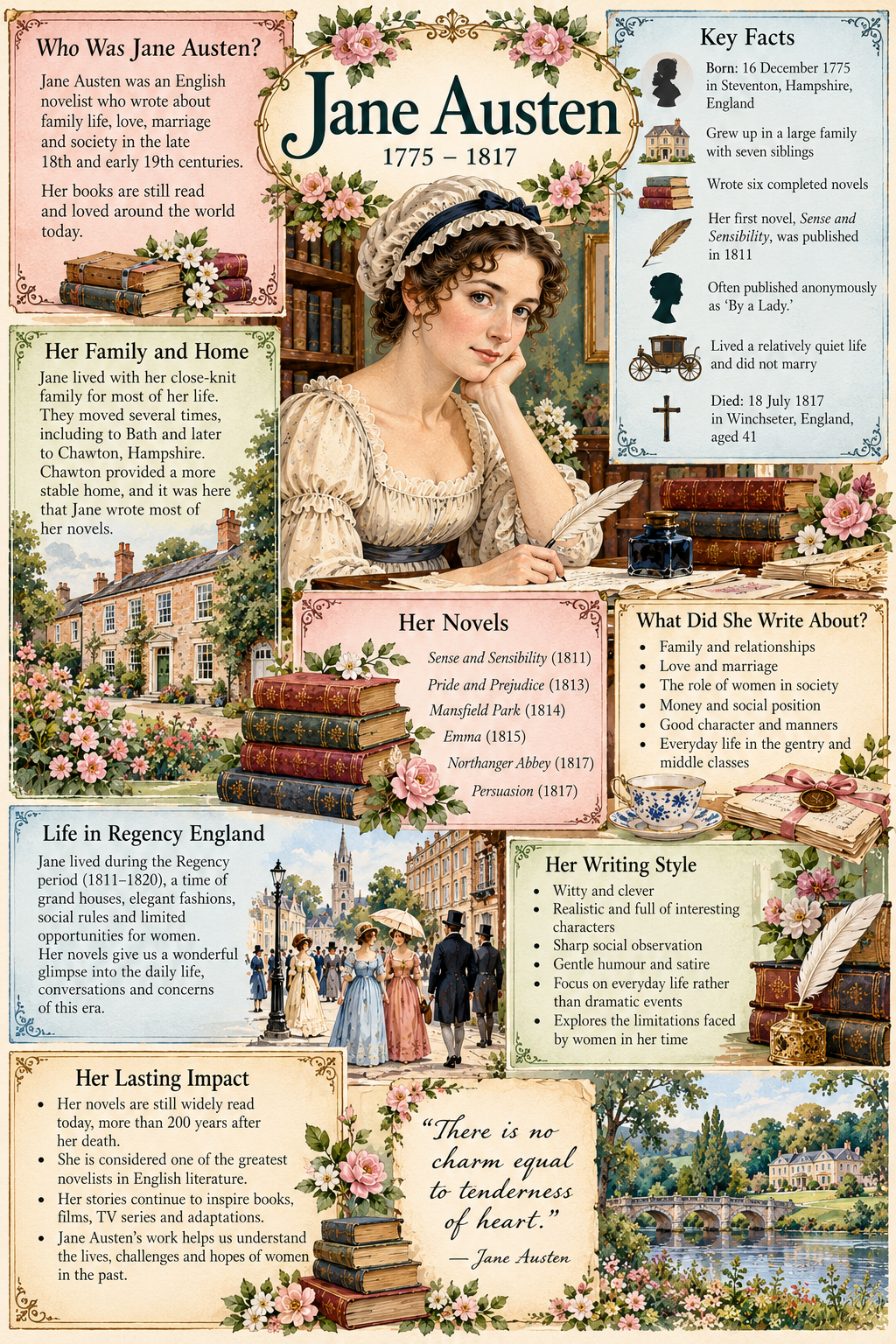
Why Did Jane Austen Publish Anonymously?
This is one of the most fascinating questions for children to investigate.
Austen’s first novel did not say:
Jane Austen
on the title page.
Instead it said:
By a Lady
That phrase had a history.
The British Library explains that ‘By a Lady’ had become a familiar way of identifying female authors, while also signalling something about the author’s social respectability.
Austen was far from the only woman to publish anonymously.
Her contemporaries included Maria Edgeworth, Ann Radcliffe, Frances Burney and, later, Mary Shelley, whose early novels were also published anonymously.
So Austen wasn’t necessarily hiding because she was ashamed of writing.
Anonymity served practical and social purposes.
A respectable woman was not necessarily expected to announce herself publicly as a professional author.
Writing could be an accomplishment.
Becoming a public literary celebrity was another matter.
Austen Never Saw Her Name on Her Novels
There is something rather extraordinary about this.
Jane Austen became one of the nineteenth century’s most successful novelists.
But during her lifetime, she did not publish her novels under her name.
Sense and Sensibility was ‘By a Lady’.
Pride and Prejudice, published in 1813, was described as being ‘By the Author of Sense and Sensibility’ rather than naming Austen.
Only after Austen’s death was her identity publicly revealed in connection with her novels. The posthumous 1818 publication of Northanger Abbey and Persuasion included a biographical notice by her brother Henry, which identified her as the author.
Imagine that.
A bestselling author whose name her readers didn’t necessarily know.
Books Were Expensive
Another useful thing to explore with children is how much books cost.
Books in this period were not cheap modern paperbacks.
Jane Austen’s Sense and Sensibility was published as a three-volume novel and advertised at 15 shillings. A newspaper advertisement appeared in The Morning Chronicle on 31 October 1811, describing the new novel as Sense and Sensibility, ‘By a Lady’.
For many people, purchasing a newly published three-volume novel wasn’t realistic.
This helps explain the importance of circulating libraries.
Instead of buying every book they wanted to read, people could borrow books.
This created an important market for novels.
Reading became an increasingly important leisure activity among the middle and upper classes.
The popularity of novels also created opportunities for writers.
How Did a Manuscript Become a Book?
Children often imagine an author writing a story and then sending it to a publisher who prints thousands of copies.
The early nineteenth-century process was very different.
A manuscript had to pass through a complicated world of:
- handwriting
- editing
- copying
- typesetting
- printing
- paper production
- binding
- advertising
- bookselling
And publishing involved financial risk.
In Austen’s case, Sense and Sensibility was published on commission, meaning Austen took on the financial risk of producing the book rather than simply selling the manuscript outright to a publisher.
This is a brilliant opportunity for an older child to investigate the economics of publishing.
What does it mean to invest your own money in a book?
What happens if nobody buys it?
And what happens if it becomes successful?
Jane Austen Was Taking a Risk
Austen had every reason to hope her novel would succeed.
But there was no guarantee.
Publishing a book involved financial risk.
She was not an established celebrity whose name alone could sell thousands of copies.
She was a woman publishing anonymously.
And yet she went ahead.
The first edition of Jane Austen’s Sense and Sensibility eventually sold out, with the 750-copy first edition reported as sold by July 1813.
The success helped establish Austen’s literary career.
Just over a year later, Pride and Prejudice appeared.
Austen was becoming a successful author.

If you’d like to download the above summary and question page, you can do so here.
What Does the Title of Jane Austen’s Sense and Sensibility Mean?
The title itself is worth exploring.
Sense can mean reason, good judgement and practical thinking.
Sensibility had a rather different meaning in Austen’s period than the modern word “sensible” might suggest.
It could refer to heightened emotional responsiveness, sensitivity and strong feeling.
The two sisters therefore give Austen a way to explore two different approaches to life.
Elinor tends to think carefully before acting.
Marianne wears her emotions much more openly.
But Austen doesn’t simply tell us that one sister is right and the other is wrong.
Both have strengths.
Both make mistakes.
And both have things to learn.
This is an excellent discussion point for children:
Is it better to think with your head, your heart, or both?
Austen’s Quiet Revolution
At first glance, Jane Austen’s novels might not look like revolutionary historical documents.
There are no battles.
No speeches about overthrowing governments.
No factories are exploding.
Instead, Austen writes about conversations, dinners, visits, dances, marriages, money and family relationships.
But those ordinary things reveal a great deal about society.
Who has money and who inherits property?
ho inherits property?
Who can work and who needs to marry?
ho needs to marry?
And who has social power, who is allowed to make decisions and who has freedom?
These questions sit underneath Austen’s stories.
That is why Sense and Sensibility can be such a valuable history resource.
It lets children investigate the past through people’s everyday lives.
Women Writers Before and Around Austen
If your children become interested in Austen, don’t stop with Austen.
A fascinating history of women writing before, during, and after the Regency period exists.
Frances Burney
Frances Burney was already a famous novelist before Austen’s first publication.
Her novel Evelina was published anonymously in 1778 and became a major success.
Austen knew her work.
Burney’s career demonstrates that women could achieve literary success, even though female authors still had to navigate complicated expectations about reputation and respectability.
Maria Edgeworth
Maria Edgeworth was another hugely successful female author.
She wrote novels about family, society, education, and moral choices.
Austen admired her work.
Ann Radcliffe
Ann Radcliffe became famous for Gothic novels, particularly The Mysteries of Udolpho.
Her writing demonstrates just how popular women’s fiction could become.
Mary Shelley
Mary Shelley belongs to the next generation.
In 1818, shortly after Austen’s death, Frankenstein was published anonymously.
This makes a wonderful comparison for older children:
Jane Austen and Mary Shelley wrote very different kinds of books, but both initially published without their names appearing on the title page.
What Made Jane Austen Different?
Austen didn’t need enormous castles, ghosts or dramatic battles to create tension.
Firstly, she could take a conversation and make it fascinating.
Secondly, she could take a visit to a country house and turn it into a study of social power.
Thirdly, she could take a marriage proposal and turn it into a question about money, independence and personal choice.
And lastly, she could make children and adults laugh at the ridiculous behaviour of supposedly respectable adults.
Her humour is one reason her novels remain so readable.
A History Lesson Hidden Inside a Novel
Reading Jane Austen’s Sense and Sensibility as part of a homeschool history study can therefore become much more than a literature lesson.
Children can investigate:
History
What was Britain like in 1811?
Women’s history
What opportunities did women have?
Social history
What did people do for entertainment?
Economic history
How did inheritance and money affect families?
Publishing history
How were books printed and sold?
Industrial history
How was Britain changing during the Industrial Revolution?
Political history
What was happening during the Regency and Napoleonic Wars?
Literary history
Why were women such an important part of the developing novel market?
Geography
Where were London, Hampshire, Devon, Sussex and Bath?
Language
What did words such as ‘sensibility’, ‘propriety’ and ‘fortune’ mean in Austen’s world?
This is precisely the kind of historical investigation that can make a book come alive.
Jane Austen’s Sense and Sensibility and Regency History Activities
These activities can be adapted for children aged approximately 5–16.
Younger children can draw, build, act and discuss.
Older children can investigate primary sources, calculate historical prices, debate social issues and conduct deeper research.
1. Become a Regency Time Traveller
Begin by creating a large timeline from approximately 1775 to 1818.
Add:
- Jane Austen’s birth: 1775
- American Revolutionary aftermath
- French Revolution: 1789
- Austen’s early writing
- Elinor and Marianne: c.1795
- Austen’s move to Bath: 1801
- Battle of Trafalgar: 1805
- Austen moves to Chawton: 1809
- George becomes Prince Regent: 1811
- Sense and Sensibility: 1811
- Pride and Prejudice: 1813
- Mansfield Park: 1814
- Emma: 1815/16
- Austen’s death: 1817
- Persuasion and Northanger Abbey published posthumously: 1818
Younger children: illustrate the timeline.
Older children: add major political, technological and literary events.
Then ask:
What was happening in the world while Jane Austen was writing?
2. The Mystery Author
Give children a piece of paper with:
A New Novel
By a Lady
Ask:
Who wrote it?
Don’t reveal Austen immediately.
Let children become literary detectives.
Give them clues:
- She was born in 1775.
- She lived in Hampshire.
- She wrote about families and relationships.
- Her first published novel appeared in 1811.
- She later wrote Pride and Prejudice.
Finally, reveal Jane Austen.
For older children, discuss why a publisher might choose not to print the author’s name.
3. Write ‘By a Lady’
Ask children to invent their own Regency-style author identity.
They could write:
A Most Extraordinary Tale
By a Lady
Younger children can illustrate the book cover.
Older children could write a short opening paragraph in an Austen-inspired style.
Then ask:
Would you want your name on the book? Why or why not?
4. Design an 1811 Book
Investigate what books looked like in Austen’s time.
Then create a mock first edition of Sense and Sensibility.
Children can design:
- a title page
- a publisher’s page
- an advertisement
- a bookseller’s sign
- a book cover
- an author page
Make sure the title page says:
By a Lady
rather than Jane Austen.
This creates a memorable way of demonstrating Austen’s anonymity.
5. The Regency Publishing Challenge
Turn your children into publishers.
Give them an imaginary manuscript.
They must decide:
- How many copies should they print?
- How much should each cost?
- How will they advertise it?
- Who will buy it?
- Should the author be named?
- What happens if the book doesn’t sell?
For older children, introduce the idea of financial risk.
Give them a fictional budget and make them calculate whether their publishing venture makes a profit or a loss.
6. Create a Regency Newspaper
Give children paper and ask them to create a newspaper from 1811.
Possible sections include:
LITERARY NEWS
‘A New Novel Published in London!’
FASHION
‘What Are Young Ladies Wearing?’
WAR NEWS
‘What Is Happening in Europe?’
SOCIAL NEWS
‘A Grand Assembly Held Last Evening’
ADVERTISEMENTS
‘Books for Sale!’
‘Fine Gloves!’
‘Lessons in French!’
‘Carriage for Hire!’
Older children can research genuine 1811 events and write their newspaper using period-appropriate language.
7. The Cost of a Book
Investigate the price of Sense and Sensibility.
The 1811 advertisement offered the three-volume novel for 15 shillings.
Ask children:
Was that expensive?
Rather than simply converting 15 shillings into modern money, investigate what the price meant compared with wages and everyday expenses.
Older children can research historical wages and compare:
- a book
- food
- clothing
- rent
- domestic service
- travel
Then discuss:
Who could afford to buy a new novel?
8. Make a Regency Library
Create a pretend circulating library.
Children can make:
- library cards
- book labels
- borrowing slips
- shelves
- miniature books
- a library catalogue
Then allow family members to borrow books.
Add rules such as:
Books must be returned within seven days.
No muddy fingerprints.
Damaged books must be reported.
For older children, research why circulating libraries were important to the popularity of novels.
9. Sense or Sensibility?
Write different situations on cards.
For example:
Someone insults you.
Your friend receives a letter from someone you dislike.
You discover that someone has been talking about you.
You receive an unexpected compliment.
You are offered something you’ve wanted for months.
Children choose:
SENSE
or
SENSIBILITY
Then explain their decision.
For older children, ask them to argue both sides.
Finish with:
Is emotional restraint always a good thing?
Is expressing your feelings always a good thing?
10. Design a Regency Character
Create a Regency character.
Children can choose:
- name
- age
- family
- wealth
- occupation
- education
- home
- interests
- social position
- hopes
- fears
Then add the most important question:
What choices does this person have?
Make a character who is:
- a wealthy young woman
- a poor young woman
- a gentleman
- a servant
- a bookseller
- a writer
- a farmer
- a naval officer
Older children can compare how social class and gender change the character’s opportunities.
11. Women Writers Investigation
Create a research project around female authors.
Give each child one writer to investigate:
- Jane Austen
- Frances Burney
- Maria Edgeworth
- Ann Radcliffe
- Charlotte Smith
- Mary Wollstonecraft
- Mary Shelley
Create a ‘Women Writers of Britain’ gallery.
Each author needs:
- portrait
- dates
- major works
- when she published
- whether she used her name
- what she wrote about
- one interesting fact
Then ask:
Were women writers unusual, or were they actually an important part of literary history?
12. The Anonymous Author Experiment
Have everyone in the family write a short piece.
Then collect them.
Remove the names.
Read the writing aloud.
Can anyone identify the author?
Discuss how different it feels to have your work judged without knowing who created it.
Then connect the experiment to Austen.
Does knowing the author’s identity change how we judge their work?
13. Regency Fashion Detective
Investigate clothing in Austen’s period.
Younger children can design Regency outfits.
Older children can investigate:
- empire-line dresses
- muslin
- shawls
- bonnets
- breeches
- waistcoats
- gloves
- shoes
- hairstyles
Then ask:
What can clothing tell us about society?
For example, who could afford fashionable clothes?
And who made them?
Also, who washed them?
Who wore practical clothing?
This can lead into a wider investigation of servants, textile production and the Industrial Revolution.
14. Jane Austen’s Writing Desk
Create a small writing station inspired by the world Austen wrote in.
Include:
- paper
- ink
- a quill or dip pen
- sealing wax
- envelopes
- ribbon
- a writing box
- books
- a small desk
Challenge children to write a short story without using a computer.
Older children can try writing a paragraph and then copying it neatly as if preparing a manuscript.
Then discuss:
How would writing change if every word had to be written by hand?
15. The Great Regency Debate
Finish your study with a family debate.
Possible questions include:
“Should Jane Austen have put her name on her book?”
“Was publishing a good idea anonymously?”
“Did women have enough freedom to become professional writers?”
“Would you have wanted to live in Regency England?”
“Is marriage mainly about love, money or both?”
“Is Elinor right to control her emotions?”
And “Is Marianne right to express hers?”
Give younger children simple choices and let them explain their opinions.
Assign older children different historical viewpoints.
For example:
- Jane Austen
- a publisher
- a wealthy young woman
- a poor woman
- a bookseller
- a male novelist
- a Regency reader
- a parent worried about reputation
The goal isn’t necessarily to reach one correct answer.
It is to understand that people in the past lived within the expectations and limitations of their own society.
A Jane Austen History Trail
If your children particularly enjoy this subject, you can turn the entire study into a Jane Austen History Trail.
Start with:
Jane Austen → women writers → books → publishing → circulating libraries → Regency society → women’s lives → marriage → money → inheritance → Industrial Revolution → Napoleonic Wars → Chawton → London
Each topic can become a mini investigation.
For example:
Books
How were they printed?
↓
Publishing
Who paid for them?
↓
Women Writers
Why did some publish anonymously?
↓
Women’s Lives
What careers were available?
↓
Marriage
Why was marriage economically important?
↓
Money
Who inherited property?
↓
Society
How did social class affect people’s choices?
Suddenly, one novel has opened up an entire period of history.
Jane Austen as a History Resource
One thing I love about using literature in a homeschool history study is that it lets children approach the past through ordinary human experiences.
Jane Austen didn’t write a textbook about Regency England.
She wrote stories.
But inside those stories are questions about:
- money
- family
- inheritance
- education
- women
- marriage
- social class
- reputation
- work
- property
- friendship
- expectations
- independence
These are historical questions.
And they are questions children can still understand.
A child may not immediately be interested in the social history of Regency England.
But they may be fascinated by a story about two sisters who have to leave their home.
They may want to know why women couldn’t simply get jobs.
Or wonder why a woman couldn’t put her name on her own book.
They may want to know why books were so expensive.
They may ask why everyone cared so much about who married whom.
And those questions are where the history begins.
The Legacy of Jane Austen’s Sense and Sensibility
When Sense and Sensibility appeared in 1811, its author was “A Lady.”
Today, Jane Austen’s name is known worldwide.
The woman whose identity was hidden from most of her original readers became one of the most studied and widely read English novelists.
But the most interesting part of the story isn’t simply that Jane Austen became famous.
It is that she was already writing, revising, experimenting and developing her voice for many years before the world knew her name.
Her journey reminds us that writers don’t become writers simply when their first book is published.
They become writers by writing and rewriting.
Also by observing, experimenting and reading.
And by asking questions and continuing even when nobody knows their name.
That makes Jane Austen an especially lovely figure for homeschoolers to study.
Because behind the famous novels is a young woman who once wrote stories for her family, developed them over many years, took a financial risk on publication, and eventually placed a novel into the world under the modest words:
By a Lady.
And that little phrase opens the door to a fascinating chapter of women’s history.
Ideas for Further Homeschool Study
If your children enjoy this topic, you could extend the study into a much larger Regency History Unit Study.
Explore:
- Jane Austen’s life
- Chawton
- Regency fashion
- Regency food
- Georgian and Regency houses
- servants
- children’s lives
- education
- women’s education
- marriage and courtship
- inheritance
- the Napoleonic Wars
- the British Navy
- the Industrial Revolution
- printing
- paper-making
- bookbinding
- circulating libraries
- newspapers
- letters
- women’s writing
- Frances Burney
- Maria Edgeworth
- Ann Radcliffe
- Mary Wollstonecraft
- Mary Shelley
- Pride and Prejudice
- Mansfield Park
- Emma
You don’t need to turn it into another traditional curriculum.
Read a book.
Write a letter.
Make a Regency newspaper.
Bake something inspired by the period.
Investigate an old map.
Create a miniature library.
Dress up.
Debate.
And, of course, read some Jane Austen.
Because sometimes the best way to study history is to let children step inside it.
A Final Question for Your Homeschool
After your children have explored Jane Austen and Regency England, ask them:
If you had been Jane Austen in 1811, would you have published your book anonymously, or put your own name on the cover?
There probably won’t be one answer.
And that’s exactly why it makes such a good history question.
Discover more from ANGELIC SCALLIWAGS
Subscribe to get the latest posts sent to your email.